




The CLARITY Act Failed, the Fed Hiked, and Bitcoin Held. What Changed?
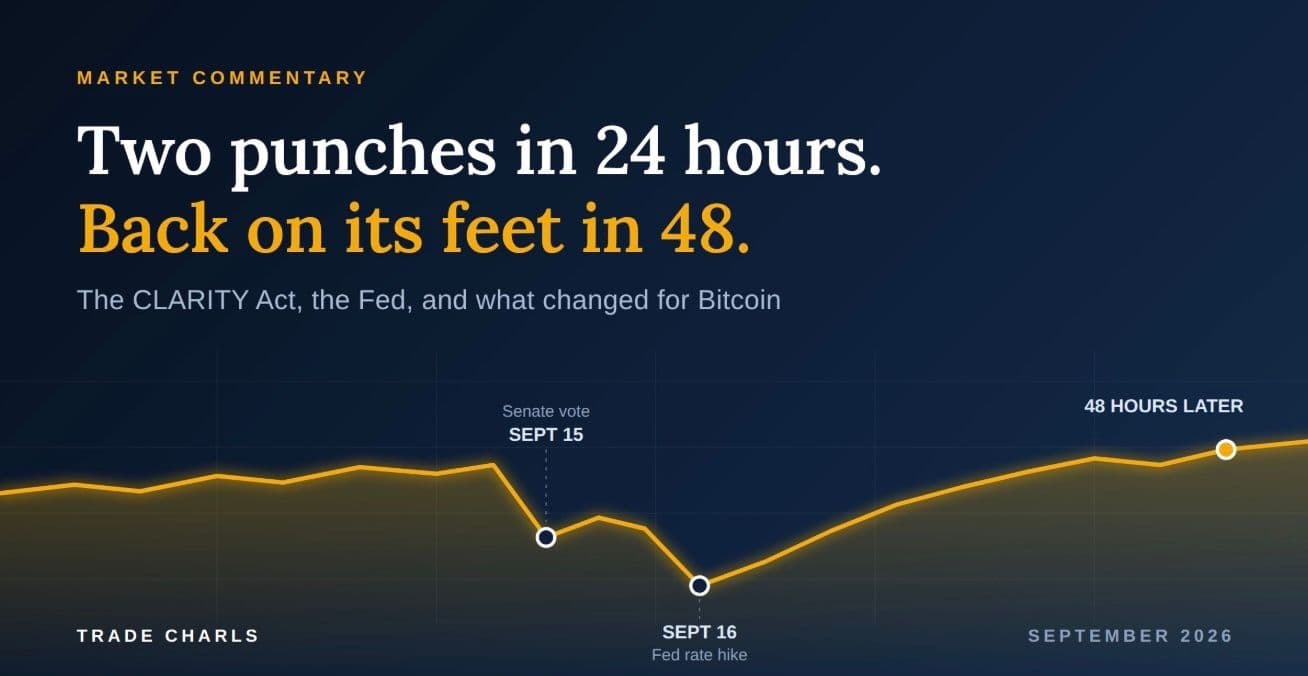
Last week should have been ugly for the crypto market. On Tuesday, September 15, the Senate voted down the CLARITY Act, 49 to 50. The bill needed 60 votes. It was meant to be the first full rulebook for cryptocurrency in the United States, and the industry had waited more than a year for it.
The next day, the Federal Reserve raised interest rates by a quarter point, to a range of 3.75% to 4%. With oil above $100 a barrel and inflation at 3.4%, Chair Kevin Warsh made it clear that fighting inflation comes first.
The Bitcoin price fell to around $76,000. Roughly $746 million left spot Bitcoin ETFs in two days. Then, within 48 hours, Bitcoin was back above $80,000. One of our co-founders is a chef, so forgive the kitchen metaphor: you find out how good your prep was when the dinner rush hits. Last week was the rush. Here is what we think held.
The people holding Bitcoin are different now. In 2022, a rate-hiking Fed flattened crypto. Most of the money in the market back then was fast money, and fast money leaves fast.
Today, spot Bitcoin ETFs hold close to $100 billion. A growing share of that sits with advisers, asset managers and institutions who rebalance on a calendar, not on a headline. Institutional adoption gets thrown around like a slogan. Last week it worked like a shock absorber.
It also helped that nobody was surprised. Markets had priced in the Fed rate hike at better than 90% odds. The bad news was already paid for.
The law stalled. The plumbing didn't.
This is the part we find most interesting. Congress could not agree on crypto regulation. Meanwhile, stablecoins have grown into a market of about $300 billion. Tokenized real-world assets (RWA) keep climbing, and tokenized US Treasuries alone are around $15 billion. Big banks and asset managers are moving funds onto blockchain rails because settlement is faster and cheaper. Fashion has nothing to do with it.
The regulators have not stopped working either. In August the SEC proposed Regulation Crypto Assets, which includes a safe harbor for token projects. Back in July we wrote that the real clarity was coming from the SEC and CFTC, and last week tested that view. We think it held.
A law would have been cleaner. But the direction of travel did not change on Tuesday.
Now, the straight talk. One good week is not a trend, and we have traded long enough to distrust a green September. Bitcoin is still more than a third below last year's record near $126,000. September 2025 was green too, and the fourth quarter that followed gave back 23%. The Fed meets again in October and December, and nobody knows what it will do. Us included.
Ethereum, altcoins, AI tokens and whatever is trending in your feed this week carry all of that risk, and then some. If you are day trading or buying the dip right now, size your positions as if you could be wrong. Any of us could be.
What we are watching into Q4. ETF flows. They turned negative in September. Whether that money comes back will tell us more than any Bitcoin price prediction. The Fed. Another hike is a headwind. A pause is a relief. Neither one is a reason to abandon a plan.
The regulators. The CLARITY Act is not dead, but it is unlikely to move before the November midterms. Until then, the SEC and CFTC carry the weight, and their rulemaking is the real crypto regulation story for the rest of 2026.
The takeaway. Crypto did not prove last week that it is safe. It showed that it has grown up a little. The market took a political defeat and a rate hike inside 24 hours and kept its footing. That is worth noticing. It is not worth betting the house on. We would love to hear how you read it. Did the crypto market pass a stress test, or did it just get lucky?
This article is market commentary from Trade Charls and is not financial advice.